
One of the best things about a sliding barn door is that it’s far simpler to fit than a conventional hinged door — there’s no frame to hang, no hinges to chisel. The door hangs from a track mounted on the wall above the opening. Here’s how it goes, and what to watch for in a South African home.
What you’ll need
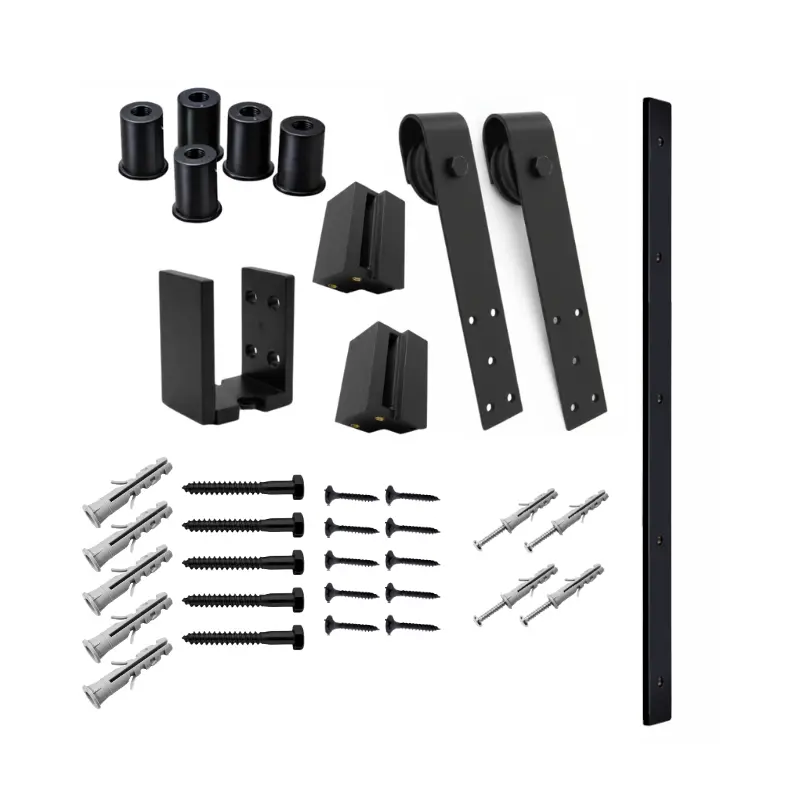
- Your barn door and its track kit (rail, rollers/hangers, wall spacers, stoppers and floor guide)
- A drill and the correct bits/fixings for your wall type (see below)
- A spirit level, tape measure, pencil and a helper for lifting
- A stud finder if you have drywall walls
Know your wall — this is the important part
Brick or concrete walls
Most South African homes have solid brick or concrete walls, which are ideal — they hold the track’s weight easily. Drill and fix the track straight into the wall using suitable wall plugs and screws (or masonry anchors) rated for the door’s weight.
Drywall / gypsum walls
A barn door and its track are heavy, and drywall on its own will not hold them. If your wall is drywall, fix the track into the timber studs behind it, or — better — mount a solid backing board (a timber rail) across the studs first, then fix the track to that. This spreads the load and lets you position the door freely. Never rely on drywall anchors alone for a barn door.
Step by step
- Mark your track height. Hold the door in the opening with a small gap at the floor (about 10–15mm), mark the top of the door, and add the space the rollers need above it (follow your kit’s measurement). This is your track line.
- Level the track line. Use your spirit level to draw a level line for the track — getting this level is what makes the door slide smoothly and sit square.
- Fix the track. Mount the rail along the line into brick/concrete, into studs, or into your backing board. Make sure every fixing is solid.
- Fit the rollers to the door and lift the door onto the track (this is the two-person moment).
- Fit the stoppers at each end so the door can’t roll off, and the floor guide at the bottom to stop the door swinging against the wall.
- Test the slide. Open and close it a few times, adjust the stoppers and guide, and you’re done.
Handy tips
- You need clear, flat wall next to the opening at least as wide as the door for it to slide onto — check for light switches or sockets in the way.
- For a bit more privacy and light-blocking, position the door so it overlaps the opening by 50–75mm on each side.
- Not a DIY person? Any handyman can fit a barn door in under an hour — it’s a quick job.
Every door comes with its track kit
Our sliding barn doors are made to order and include the complete track kit, so everything’s matched and ready to fit. Delivered nationwide from our Gauteng workshop.
This is a general guide — always follow the specific instructions supplied with your track kit, and if in doubt, use a qualified handyman.